Alice In Chains Download Dirt
Is ' major artistic statement and the closest they ever came to recording a flat-out masterpiece. It's a primal, sickening howl from the depths of 's heroin addiction, and one of the most harrowing concept albums ever recorded. Not every song on is explicitly about heroin, but 's solo-written contributions (nearly half the album) effectively maintain the thematic coherence -- nearly every song is imbued with the morbidity, self-disgust, and/or resignation of a self-aware yet powerless addict.
Alice In Chains - Dirt Free Mp3 Download. Also we have other songs of the Alice In Chains available, songs from the Dirt, also Mp3 formats of this songs. Also you can. Dirt is the second studio album by the American rock band Alice in Chains, released on September 29, 1992.
's technically limited but inventive guitar work is by turns explosive, textured, and queasily disorienting, keeping the listener off balance with atonal riffs and off-kilter time signatures. 's stark confessional lyrics are similarly effective, and consistently miserable. Sometimes he's just numb and apathetic, totally desensitized to the outside world; sometimes his self-justifications betray a shockingly casual amorality; his moments of self-recognition are permeated by despair and suicidal self-loathing. Even given its subject matter, is monstrously bleak, closely resembling the cracked, haunted landscape of its cover art. The album holds out little hope for its protagonists (aside from the much-needed survival story of 'Rooster,' a tribute to 's Vietnam-vet father), but in the end, it's redeemed by the honesty of its self-revelation and the sharp focus of its music. [Some versions of feature 'Down in a Hole' as the next-to-last track rather than the fourth.].
• ' Released: June 30, 1992 • ' Released: September 8, 1992 • ' Released: December 6, 1992 • ' Released: March 15, 1993 • ' Released: August 30, 1993 Dirt is the second studio album by the American band, released on September 29, 1992, through. Peaking at number six on the, the album was also well received by music critics. It has since been certified four-times platinum by the and gone on to sell five million copies worldwide, making Dirt the band's highest selling album to date. It is the band's last album recorded with all four original members, as bassist was terminated from the band in January 1993. The album spawned five singles: ', ', ', ', and '; all with accompanying music videos. The songs on the album focused on depression, pain, anger, anti-social behavior, drug addiction (primarily ), war, death, and other emotionally charged topics. Rolling Stone listed the album at No.
26 on its list of the 100 Greatest Metal Albums of All Time. Contents • • • • • • • • • • • • • Background and recording [ ] The recording of Dirt began in the spring of 1992. Producer, who had previously worked with the band on their debut,, wanted to work with them again. He admired vocalist 's lyrics and voice, and lead guitarist 's guitar riffs. The track ' produced, engineered and mixed by, was recorded before the album, and first appeared on the to the 1992 movie.
Dirt was recorded at Eldorado Recording Studio in, in, and One on One Studios in from March to May 1992. [ ] When recording the album, Staley had previously checked out of rehab in and quickly went back to using. [ ] Drummer said in a 2005 interview [ ] that Staley had told Kinney that he was high on heroin and marijuana during the recordings of 'Down in a Hole' and ' as well as taking for back pain. [ ] Cantrell had also agreed with Kinney's report, [ ] saying that Staley, Jerden and the rest of the band would smoke marijuana in the studio room, even saying that Staley would shoot heroin in front of everyone. [ ] Jerden later said that he was told Staley felt animosity toward him dating back to the Dirt sessions due to Jerden repeatedly recommending to Staley that he get sober at the time. Jerden said, 'Apparently he got all mad at me [during the Dirt sessions].
And what's my job as a producer? To produce a record. I'm not getting paid to be Layne's friend.' Staley was not the only one who went through heavy drug use; Sean Kinney and bassist were also struggling with alcohol addiction. [ ] Cantrell was also going through severe clinical depression [ ] from the deaths of his mother and his friend,, and used, [ ] an anxiety medication prescribed by his doctor to ease his depression as well as his heavy drinking on tour. [ ] 'I was going through a tough time, everyone was, but that's what made the album stronger and more intense, I look back on that period of time as the longest four years of sex, drugs and alcohol we all went through,' Cantrell said in a 2007 interview with.
[ ] Music and lyrics [ ]. A sample of ' from Dirt. The song originally appeared on the to the film. Is one of Alice in Chains' signature songs, appearing at nearly every concert the band has performed since its release. Problems playing this file? With songs written primarily on the road, the material has an overall darker feel than Facelift. 'We did a lot of soul searching on this album.
There's a lot of intense feelings.' Cantrell said, 'We deal with our daily demons through music. All of the poison that builds up during the day we cleanse when we play'. Drug use was front and center as a lyrical theme on the album. Three tracks (Sickman, Junkhead & God Smack) specifically reference heroin use and its effects.
Staley later expressed regret about the lyrical content of some songs on Dirt, explaining, 'I wrote about drugs, and I didn't think I was being unsafe or careless by writing about them. I didn't want my fans to think that heroin was cool. But then I've had fans come up to me and give me the thumbs up, telling me they're high.
That's exactly what I didn't want to happen.' Cantrell said in 2013: 'That darkness was always part of the band, but it wasn’t all about that. There was always an optimism, even in the darkest shit we wrote. With Dirt, it’s not like we were saying ‘Oh yeah, this is a good thing.’ It was more of a warning than anything else, rather than ‘Hey, come and check this out, it’s great!’ We were talking about what was going on at the time, but within that there was always a survivor element – a kind of triumph over the darker elements of being a human being. I still think we have all of that intact, but maybe the percentage has shifted.' Cantrell told magazine in 1993 that not all of the lyrics have drug reference: I think 'Sickman' is not that bad.
I thought most of the hassle would come from 'Junkhead' and 'Godsmack'. Those songs are put in sequence on the second side those five songs from 'Junkhead' to 'Angry Chair' for a reason: Because it tells a story. It starts out with a really young naive attitude with 'Junkhead', like drugs are great, sex is great, rock'n' roll, yeah!
Then, as it progresses, there's a little bit of growing up and a little bit of a realization of what it's about, and that ain't what it's about. I've been using this phrase a lot, but it makes a lot of sense: It's really easy to die; it's really hard to live. It takes a lot of guts to live. It doesn't take a lot of guts to die. Those five and 'Sickman' are the only ones talking about that type of mentality [drugs]. The rest of the stuff is not like that at all.
'Rain When I Die' is a song to a girl. There's a lot of stuff on it. A good portion of it is a story, and it's meant to be that way. It's kind of overwhelming and unpleasant at times, unsettling maybe, but that's why all those songs are together. Even if it's disturbing, it's not something anybody else needs to worry about or the way somebody else needs to live their life. On the of 1999's box set collection, Cantrell cited 'Junkhead' and 'God Smack' as 'the most openly honest' songs about drug use.
Cantrell said he wrote ' about 'mortality, that one of these days we'll end up a pile of bones.' He told RIP magazine in 1993: 'Them Bones' is pretty cut and dried. It's a little sarcastic, but it's pretty much about dealing with your mortality and life. Everybody's going to die someday. Instead of being afraid of it, that's the way it is: so enjoy the time you've got.
Live as much as you can, have as much fun as possible. Face your fear and live. I had family members die at a fairly early age; so I've always had kind of a phobia about it. Death freaks me out. I think it freaks a lot of people out. It's the end of life, depending on your views.
It's a pretty scary thing. 'Them Bones' is trying to put that thought to rest.
Use what you have left, and use it well.' Cantrell was inspired to write 'Dam That River' after a fight he had with Sean Kinney, in which Kinney broke a coffee table over his head.
'Rain When I Die' is a song to a girl, according to Cantrell. 'Sickman' came together after Staley asked Cantrell to 'write him the sickest tune, the sickest, darkest, most fucked up and heaviest thing [Cantrell] could write.'
'Rooster' was written by Cantrell for his father, who served in the. His nickname was 'Rooster'.
Cantrell described the song as 'the start of the healing process between my Dad and I from all that damage that Vietnam caused.' Discussing the title track 'Dirt', Cantrell stated that 'the words Layne put to it were so heavy, I've never given him something and not thought it was gonna be the most bad-assed thing I was going to hear.' The 43-second 'Iron Gland' was developed out of a guitar riff that Cantrell would play that annoyed the other band members, so he created the song (adding in a reference to 's ') and promised to never play the guitar riff again, although the track is played as intro music in concert. It features of band on vocals, as well as Layne Staley. 'Hate to Feel' and 'Angry Chair' were both composed solely by Staley, and Cantrell has expressed his pride in seeing Staley grow as a songwriter and guitarist. ' was written by Cantrell to his long-time girlfriend. Cantrell explained the song on the liner notes of 1999's Music Bank box set: '['Down in a Hole']'s in my top three, personally.
It's to my long-time love. It's the reality of my life, the path I've chosen and in a weird way it kind of foretold where we are right now. It's hard for us to both understand.that this life is not conducive to much success with long-term relationships.' The album's final track, ', was written by Cantrell and concerns the late lead singer of,. Cantrell said the song is also 'directed towards people who pass judgments.' Packaging [ ] The album's features a woman half buried on a cracked desert. The cover was photographed.
For many years, fans believed that the model on the cover was Layne Staley's then-girlfriend, Demri Parrot, but Schneck revealed to Revolver Magazine in 2010 that the girl was actually model/actress, with whom he had previously worked on the single cover of '. The magazine also published behind the scenes photos from the shoot featuring O’Brien.
Schneck told Revolver Magazine: Everyone always asks if that is Demri Parrott on the “Dirt” Cover. I think Demri’s name might have been mentioned as a possible model once or twice, but it was never a serious consideration. After the eight hour photo session, O’Brien went to the bathroom and left her wig embedded in the dirt.
Schenck snapped a few photos, which were later used for the 1999 box set. The cover was referenced on the music video for Alice in Chains' 2009 single ' '.
At the 6:55 mark of the video, a woman is seen lying on a cracked desert floor similarly to Dirt's cover. Release and critical reception [ ] Professional ratings Review scores Source Rating B A 5/5 7/10 8/10 This was the band's breakthrough album. Upon its release in September 1992, Dirt peaked at number six on the and went on until its 106th week, ending at number 194. Dirt was released on the same day as another important album of the grunge era,.
Dirt granted Alice in Chains international recognition, and the album was certified four times platinum status in the United States, platinum status in Canada and gold status in the UK. The album had sold 3,358,000 copies in the United States as of 2008. Dirt received critical acclaim, and is considered by critics and fans alike as the group's best album. In a retrospective review, Steve Huey of said ' Dirt is Alice in Chains' major artistic statement and the closest they ever came to recording a flat-out masterpiece. It's a primal, sickening howl from the depths of Layne Staley's heroin addiction, and one of the most harrowing concept albums ever recorded. Not every song on Dirt is explicitly about heroin, but Jerry Cantrell's solo-written contributions (nearly half the album) effectively maintain the thematic coherence—nearly every song is imbued with the morbidity, self-disgust, and/or resignation of a self-aware yet powerless addict.'
Michael Christopher of praised the album saying 'the record wasn't celebratory by any means -- but you'll be hard pressed to find a more brutally truthful work laid down -- and that's why it will always be one of the greatest records ever made.' Chris Gill of called Dirt 'huge and foreboding, yet eerie and intimate,' and 'sublimely dark and brutally honest.'
Don Kaye of described Dirt as 'brutally truthful and a fiercely rocking testimonial to human endurance'. It was voted ' Kerrang! Critic's Choice Album of the Year' for 1992. In 2011, Joe Robinson of Loudwire named Dirt as one of the best albums of the 1990s, alongside other albums such as 's and 's, writing 'In the battle between metal and grunge, Alice in Chains are a rare band that is embraced by fans of both genres. The most metal of the Seattle bands, they were marketed as metal for 1990's 'Facelift,' then touted as grunge for 1992's 'Dirt.'
The band members themselves didn't bother much with labels, they just churned out some of the finest alt-metal with classics like 'Would?,' 'Rooster' and 'Them Bones' leading their charge all the way to the headlining spot on Lollapalooza '93.' Dirt is often considered as one of the most influential albums to the subgenre, which fuses with. Dirt included the singles ', ', ', ', and ', all of which had accompanying. Dirt spawned five top 30 singles, including 'Rooster', 'Them Bones', and 'Down in a Hole', and remained on the charts for nearly a year.
At the, Dirt received a nomination for. The band also contributed the song 'Would?' To for the 1992 film, whose video received an award for at the. Dirt was named 5th best album in the last two decades by Close-Up magazine. Dirt was also included in the 2005 book. In October 2011, the album was ranked number one on magazine's top ten list of guitar albums of 1992, with 's in second place and 's in third place. Staley playing with Alice in Chains in in 1992.
Alice in Chains was added as openers to 's No More Tours tour. Mere days before the tour began, Layne Staley broke his foot in an accident, forcing him to use crutches on stage. While on tour, Starr was kicked out of the band and was replaced by former Ozzy Osbourne bassist. During the summer of 1993, Alice in Chains joined,, and for the festival, which was the last major tour Alice in Chains played with Staley. Track listing [ ] All music composed by, except where noted. Title Lyrics Music Length 1.
'Dam That River' Cantrell 3:09 3. 'Rain When I Die' Cantrell,, 6:01 4. 'Sickman' Staley 5:29 5. ' Cantrell 6:15 6. 'Junkhead' Staley 5:09 7. 'Dirt' Staley 5:16 8. Leadership And Performance Beyond Expectations Bass 1985 Pdf Files.
'God Smack' Staley 3:56 9. 'Untitled' (unlisted) 0:43 10.
' Staley Staley 5:15 11. ' Staley Staley 4:48 12.
' Cantrell 5:38 13. ' Cantrell 3:28 Total length: 57:37 I On the,, and later and versions of the CD, 'Down in a Hole' is located between 'Rain When I Die' and 'Sickman'.
On earlier U.S. And Canadian pressings, it is placed between 'Angry Chair' and 'Would?' II Track 9, 'Iron Gland', appears without a title on the album. The title appeared on and. The lists it incorrectly as 'Iron Man'. Before the name 'Iron Gland' was revealed, it was labeled in some online databases as 'Intro (Dream Sequence)'. On editions in which 'Down in a Hole' is track 4, 'Iron Gland' is track 10.
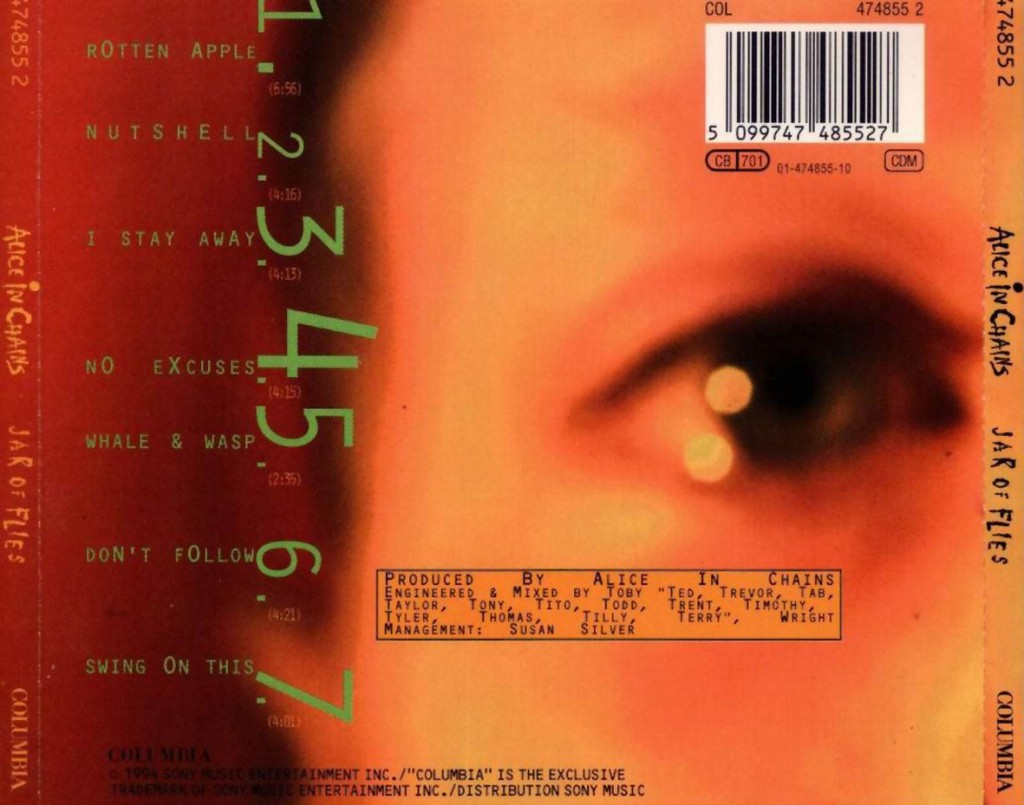
The track was removed on some editions. Some editions may merge the track with 'Hate to Feel' III On the back cover of the edition in which 'Iron Gland' is track 9, 'Hate to Feel', 'Angry Chair', 'Down in a Hole' and 'Would?' Are listed from 9–12. However, when the CD is played, the songs are on tracks 10–13.
Outtakes [ ] The songs ' and 'Lying Season' were featured on Alice in Chains' 1991 demo tape that featured songs from and Dirt. Both of these songs were later included on the band's 1999 box set,. 'Fear the Voices' was released as a single in 1999 to promote Music Bank and became a radio hit that same year. Regarding the two songs, Cantrell said that they came from a time when the band was still developing its sound. Personnel [ ]. Alice in Chains • –, on 'Angry Chair' and 'Hate to Feel' • – and,, on 'Down In a Hole', co-lead vocals on 'Would?' • ^ Robinson, Joe..
Retrieved 23 September 2015. • (album notes). Alice in Chains.. Archived from on July 3, 2006. Retrieved February 9, 2008. Rolling Stone.
Retrieved 2017-09-28. • ^ Fischer, Blair R.. Rolling Stone. Retrieved January 30, 2008. • ^ Turman, Katherine (February 1993). 'Digging Dirt'.
RIP magazine. • Kleidermacher, Mordechai (July 1990). 'Link with Brutality'. • Wiederhorn, Jon (February 8, 1996).. Rolling Stone. Retrieved January 30, 2008.
• Dave Kerr (13 November 2013).. Retrieved 25 July 2017. RIP Magazine - February 1993.
Archived from on October 14, 2003. Retrieved 2014-03-31. • ^ Liner notes, box set.
Retrieved 2016-07-27. July 8, 2017. Retrieved November 4, 2017. 21 June 2014. Retrieved 22 July 2017. 2 September 2009. Retrieved 22 July 2017.
• ^ Huey, Steve... Retrieved May 29, 2013. • Herrmann, Brenda (October 22, 1992)... Retrieved September 9, 2016.
Christgau's Consumer Guide: Albums of the '90s.. Retrieved October 31, 2015.
(5th concise ed.)... • Garza, Janiss (October 16, 1992)... Retrieved August 23, 2009. • ^ Kaye, Don (October 3, 1992). 'Alice in Chains 'Dirt '.. • 'Alice in Chains: Dirt'. February 2002.
'Alice in Chains'. Dvd Fab Passkey Download there. In Brackett, Nathan; Hoard, Christian... • Weisbard, Eric; Marks, Craig, eds. • 'Alice in Chains: Dirt'.
December 1992. Rovi Corporation. Retrieved 2013-05-29.
Retrieved on December 11, 2008. • April 12, 2009, at the.. Retrieved on December 11, 2008. NB: enter 'alice in chains' in 'artist name' and click 'Search'. Retrieved on December 11, 2008. • Caulfield, Keith...
Retrieved November 20, 2012. • ^ Christopher, Michael (September 23, 2003)... Retrieved November 16, 2012. • ^ Gill, Chris (September 1999). • '1992 Kerrang! Critic's Choice Albums of the Year'.
(423): 17–19. December 19, 1992. access-date= requires url= () • Conway, James.. Vulture Hound Magazine. Retrieved November 16, 2012.
Retrieved November 9, 2007. • Wiederhorn, Jon (April 6, 2004)... Retrieved December 22, 2007. Retrieved December 8, 2007. Retrieved December 8, 2007.
April 30, 2008. Retrieved November 20, 2012.
• Grassi, Tony... Retrieved October 24, 2011. Archived from on July 19, 2006.
Retrieved December 14, 2007. • D'Angelo, Joe (April 20, 2002)... Retrieved November 25, 2007. • ^ at (list of releases). Retrieved September 4, 2013. Retrieved 14 August 2016.
November 14, 1992. Retrieved on December 11, 2008. • (in Dutch). Retrieved 14 August 2016. • (in German). Retrieved 14 August 2016. Retrieved 14 August 2016.
Retrieved 14 August 2016. Retrieved 14 August 2016. Retrieved 14 August 2016. Retrieved 14 August 2016. Prometheus Global Media.
Retrieved 2013-11-02. Prometheus Global Media. Retrieved 2013-11-02. • Pennanen, Timo (2006). (in Finnish) (1st ed.). Helsinki: Tammi.. Archived from on June 9, 2009.
Retrieved 2009-07-18. • (in Dutch). Retrieved 2008-02-14. • officialcharts.com. Retrieved August 14, 2016.
Retrieved 26 February 2017. Enter Dirt in the search field and then press Enter.
If necessary, click Advanced, then click Format, then select Album, then click SEARCH.