Java Rxtx Usb Serial Ch340
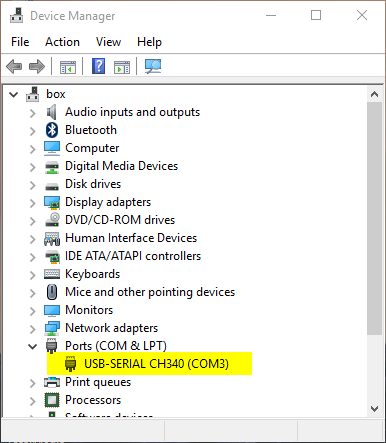
I'm posting this mostly as a note to myself, but maybe useful to others too. Free Download Suara Sirine Perang. This is a simple python program to log lines of text to a file (my application is logging NMEA data from a GPS). This isn't specific to GPS, but it uses line buffering so your data strings need to end with a ' r' carriage return (or other character, if you want to change it).
I'm using the Pi's built-in UART on the GPIO pins, so I first need to disable the Linux serial console which would otherwise occupy it. This is easily done with the serial console enable/disable script from AndrewS here. Code: Traceback (most recent call last): File './log.py', line 14, in spb.readline() # throw away first line; likely to start mid-sentence (incomplete) File '/usr/lib/python2.7/codecs.py', line 296, in decode (result, consumed) = self._buffer_decode(data, self.errors, final) UnicodeDecodeError: 'utf8' codec can't decode byte 0xa2 in position 0: invalid start byte Apparently when starting the python Serial process asynchronously with the GPS already throwing data at the port, you may start mid-character which appears to be a non-ASCII character and causes this mysterious utf8 codec error. To fix this, I edited my previous post to tell the io code to ignore errors. The file in my first post that begins with: #!/usr/bin/python is a Python language program. That first line says which program can interpret it: the 'python' language interpreter which is located at /usr/bin/python. You save the text in a file, which can be named anything you like but traditionally ending in.py, for example serial-log.py and the file can be saved in any directory.
You could use /usr/bin/ if you want, but you can put it anywhere. (Note: on the standard R-Pi install, /usr/bin/python is a symlink to the python2.7 interpreter, and not a directory.) Then, in that same directory as your python program, if you type 'python serial-log.py' (or whatever you named it) the program should run.
Mac OS X Drivers for CH340 / CH341 / PL2303 USB to RS-232 Devices. We offer the best USB to serial drivers for Prolific PL-2303 and Winchiphead CH-340 / CH-341 / HL-340 for based on the HL-340 / CH-340 / CH-341 Driver (V3.0.3).Statement: periodically updates software information of PL2303 USB to Serial Driver.
Or you'll see some kind of error message if something went wrong. If you want, you can also make the file itself executable: 'chmod +x serial-log.py' and then you can simply invoke it directly without first calling python, eg './serial-log.py' if you are in the same directory, or the full pathname if you aren't, for example '/home/pi/test/serial-log.py' If you want to learn how to write python yourself, there are lots of tutorial sites online, like There's even a book about Python and the R-Pi. I am doing an project using E-health sensor shield which is compatible with arduino uno and raspbery pi boards.The problem is that for my project i have to collect real time data to a file in my computer/laptop and in arduino there is no chance without using sd card. But i cant use sd card as i have to remove it from arduino and plug it into pc. The sensed data for this reason is not real time.
I have to directly store them them into a file. Is there a way exist to accomplish that????please suggest a way. THANK YOU,,PLEASE REPLY. Hello JBeale, I hope you don't mind me hijacking this thread but I thought you might be able to help me.

Gamez Aion Multi Trainer Download Free. I have posted this question elsewer but have not received any replies. Here is my original post - if you are able to help in any way I will be eternally grateful. ============= After days of trying to get my Serial to USB to work I am no further forward - I am trying to log NMEA sentences from a GPS Module via USB to Serial connection. I have two RS232 to USB leads: Bus 001 Device 010: ID 067b:2303 Prolific Technology, Inc. PL2303 Serial Port Bus 001 Device 011: ID 1a86:7523 QinHeng Electronics HL-340 USB-Serial adapter and both work on a Windows XP machine, which is frustrating to say the least. When I try on my Pi I receive garbled text no matter what speed/parity/stopbits I choose.
I am using Minicom to see the incoming data. I have read, and tried solutions therein, many reports on this and other forums without making any progress. I'm beginning to doubt my sanity! Does anyone have any idea however bizarre it might seem that might help me? Serial comms is not difficult but I seem to have come up against a brick wall.
Hi scruss, thanks for your hints. I've tested the device on Windows and 4800 8N1 is what the GPS is using.
Regarding your suggestion to use modprobe - when I type it nothing is returned which might be a pointer. Trouble is I'm not too good with intricate Linux code so don't know where to go from here. Here are the last few lines from dmesg pi@GEO-006 ~ $ sudo dmesg -C pi@GEO-006 ~ $ sudo dmesg [33] usb 1-1.4: new full-speed USB device number 12 using dwc_otg [97] usb 1-1.4: New USB device found, idVendor=1a86, idProduct=7523 [23] usb 1-1.4: New USB device strings: Mfr=0, Product=2, SerialNumber=0 [40] usb 1-1.4: Product: USB2.0-Ser! [19] ch341 1-1.4:1.0: ch341-uart converter detected [69] usb 1-1.4: ch341-uart converter now attached to ttyUSB0 pi@GEO-006 ~ $ And here is the output from lsusb pi@GEO-006 ~ $ lsusb Bus 001 Device 002: ID 0424:9514 Standard Microsystems Corp. Bus 001 Device 001: ID 1d6b:0002 Linux Foundation 2.0 root hub Bus 001 Device 003: ID 0424:ec00 Standard Microsystems Corp. Bus 001 Device 012: ID 1a86:7523 QinHeng Electronics HL-340 USB-Serial adapter pi@GEO-006 ~ $ Any help will be much appreciated, thanks.
I´m having similar issue. Same vendor and productID. Same dmesg output (all looks good), but the cable cannot read info. This cable on windows works (so it´s not a cable issue) I´ve tried another cable with FTDI chipset (another vendor and product ID) and it works (so speed/bound, parity, etc are set correctly) It seems like this vendor chipset doesn´t work with this driver (Ch-341). I don´t know exactly how to do that, but should I try to force to load another module on raspberry (say pl23.) to give it a try? Thanks for you reply.
I´m not using GPIOs, these cable come with a DB9 conector in one end and an USB in another. I have a few cables. All FTDI work well. I realize my problem is with QinHeng HL-340 cables. A few of them work, but most of them not (it seem to be from different manufactures, but they seem to use this same chipset) all of them (the one that work and the ones that don´t) when I plug and DMESG, they say vendor=1a86 product=7523 attached to 'ttyUSB0' and LSUB shows: QinHeng Electronics HL-340 USB-Serial adapter in Windows all of them work. This is driving me crazy could it be because tx and rx are inverted and in windows the driver realizes that? Any other ideia?
Many thanks!!!